


.webp?width=750&height=375&name=Why-med-tech-training-systems-fail-as-they-scale%20(1).webp) In the earliest stages of building a medical device business, training compliance is often handled with a DIY approach. We use spreadsheets to track who’s read what, cloud folders for SOPs, maybe a few DocuSign trails for sign-off. For a small team, it’s manageable.
In the earliest stages of building a medical device business, training compliance is often handled with a DIY approach. We use spreadsheets to track who’s read what, cloud folders for SOPs, maybe a few DocuSign trails for sign-off. For a small team, it’s manageable.
But as your headcount grows - and your product, process, and regulatory burden grow with it - that fragile setup can start to crack.
What worked for five or six people can easily become chaos as you hit twenty. Without a system that defines training requirements across a team and then tracks training automatically, you risk failing audits and increasing quality issues.
The risk of inadequate training in med tech companies
- According to the FDA, training-related issues have been among the top 10 causes of Form 483 observations in life sciences for the past five year.
- In biomedical research, they’ve consistently ranked in the top six.
- In 2024, 15% of Form 483 observations for medical device companies were directly tied to training deficiencies.
- all these 483 observations, the majority centred around inadequate process and documentation
.webp?width=4164&height=1731&name=Training-Related-FDA-483-Citations-(Devices%20Sector).webp) For companies who are growing fast it’s easy to lose control of training documentation without having a central management system for these records.
For companies who are growing fast it’s easy to lose control of training documentation without having a central management system for these records.
9 ways training management can fail as your business scales
1. Relying on manual documentation
Regulators like the FDA, ISO, and EMA require strict control over training documentation. Spreadsheets offer no audit trail, version control, or electronic signatures. Without a system that complies with FDA 21 CFR Part 11 or ISO 13485:2016 Clause 6.2, it becomes difficult to prove training happened, let alone that it was effective.
2. Relying on self-attestation
Letting team members tick a box to confirm they've read a document isn't enough. Regulatory standards require proof of comprehension. This can mean assessments, quizzes, or sign-off from a qualified manager.
As your team expands, co-ordinating these kind of approvals manually becomes unworkable. A compliant training system must support secure, automated testing and third-party verification with proper audit trails.
3. Treating training as a one-time event
Initial onboarding is only one part of the picture. If you’re not retraining when SOPs or regulations change, your team may be following outdated processes.
Out-of-date training content is a major audit finding and a direct risk to product quality and patient safety. You need a process that links training requirements to document changes automatically.
4. Treating training as a one-size-fits-all process
When ‘everyone does everything’ in a business, a one size fits all approach to training can be justified. But as you scale, roles become more specialised and you need to tailor your approach.
ISO 13485 and FDA QMSR all require role-specific training to ensure that people are competent to undertake the tasks central to their jobs.
Without tailored learning paths, you risk undertraining some staff and overloading others. More importantly, you can't demonstrate job-specific competence to auditors.
5. Training management systems fail to engage
Who has got time to digest reams of written text? Who wants to wade through tons of written tests? And who has got time to ‘mark the work’. As the scope and complexity of training grows you need a system that can make training programmes straightforward to complete and results easy to assess.
Choose a LMS system that is multimedia, that can let you build individual training programmes for your team using video, quizzes and other interactive tools.
Research shows that with a large audience of different kinds of learners to train, choosing tools that maximise engagement ensure the best results.
- E-learning reduces typical training time by 40% - 60% (Brandon Hall Group)
- 77% of knowledge workers say personalised training increases engagement (Oak Innovation)
- 50% of workers prefer digital training sessions under 30 minutes (Shift Learning)
- Gamification of the learning process boosts retention by up to 40% (TalentLMS)
6. Lack of training, visibility and automated reminders
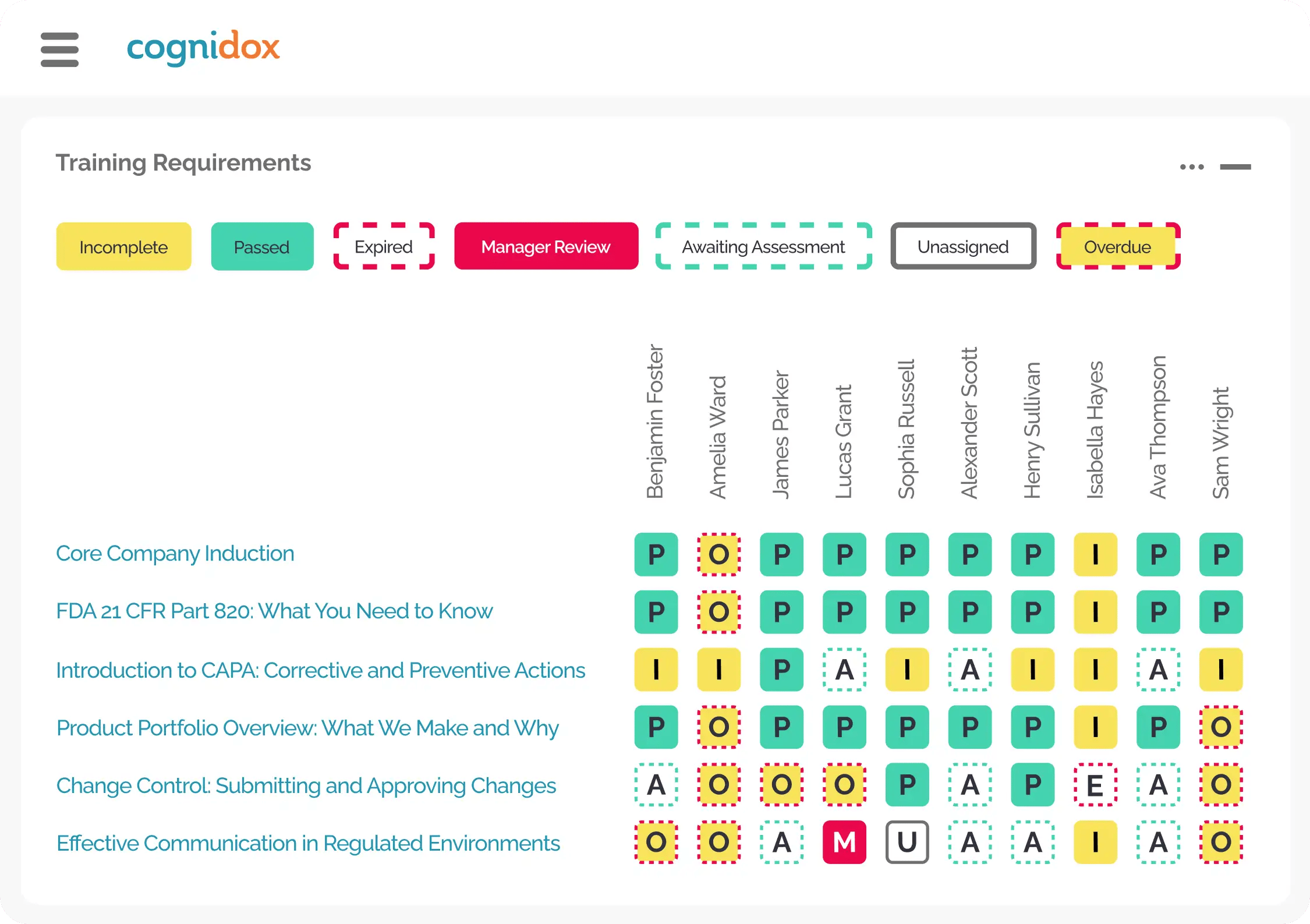
If you can’t easily see who’s been trained, what’s overdue, or where the gaps are, you can’t manage compliance.
An effective training system provides a live training matrix and sends automated reminders to users and managers. Without it, important deadlines get missed, and audit readiness suffers.
7. Not linking training to change control
When a procedure changes, relevant training must follow. If your training isn’t tied to document control, there maybe no automatic trigger for retraining.
This may result in staff unknowingly following obsolete procedures, creating immediate compliance and safety risks.
8. Poor integration with the wider QMS
Training doesn’t live in isolation. It needs to integrate with your document management, CAPA, and audit systems.
If a CAPA is raised due to training issues, there should be a clear link back to individual records. Disconnected systems make it impossible to demonstrate a closed-loop quality process to inspectors.
9. Using a system that isn’t validated
If your LMS isn't validated, your training records may be rejected by auditors.
FDA and ISO expect systems used in regulated processes to go through IQ, OQ, and PQ testing. Your LMS must come with validation support and documentation to prove it works as intended.
Where training management goes wrong for growing med tech companies
In the early days, a DIY approach to training may feel lean and pragmatic. But as your company grows, so do your risks.
Manual tracking, scattered tools, and generic LMS platforms can’t deliver the level of control, visibility, or regulatory readiness that today’s med tech environment demands
Ironically, research shows that smaller companies spend more per head on training than large enterprises. That’s because fragmented systems create inefficiencies, duplication, and rework - costing more in time, resources, and audit preparation.
Choosing an eQMS with a LEAN training management system built in can change that equation.
It can help you grow your training regimes in a controlled way, letting you define requirements and track completion in ways that satisfy regulators, but still work for you
An eQMS like Cognidox can help you reduce administrative overhead, connect your training to your quality outcomes, and create a single source of truth for proving competence and compliance.



%20(1).webp?width=133&height=76&name=ISO%20IEC%2027001%20(1)%20(1).webp)